How do you get Flanders talking? Lessons from Maarallee
Why doesn’t AI always understand us when we simply speak Flemish? With Maarallee, Scivil worked with citizens to collect Flemish speech data to help automatic speech recognition better understand the way people in Flanders really speak. The project is part of NELF, the Corpus of Spoken Flemish, and was developed in collaboration with KU Leuven (PSI), with support from WEWIS. At the same time, Maarallee was a large citizen science experiment: how do you convince enough different people across Flanders to donate their voice? Isaak Vandermaesen, AI & Education Project Coordinator at Scivil, and Alyssa Lambrecht, Communications Adviser at Scivil, look back on their search for participants, their experiments to reach different target groups and the lessons they learnt along the way.
AI that understands Flemish too
What did you want to achieve with Maarallee?
Isaak Vandermaesen: “NELF, the Corpus of Spoken Flemish, mainly wanted to crowdsource enough diverse Flemish speech, with the correct consent, to train an AI model on it later. Scivil was asked to design and run the public campaign, which we eventually named Maarallee.
For us, that also raised an interesting question: can we collect enough Flemish speech to train an AI dataset based on the goodwill of citizens? And, above all, how do you go about it?”
Why is it so important to collect Flemish speech specifically?
Isaak Vandermaesen: “As with all AI technologies, the quantity and quality of the data are crucial to the eventual application. Speech recognition that needs to understand Flemish must be able to take into account the enormous geographical variation within the Flemish-speaking region. West Flemish sounds different from Limburgish, for example. So you need a lot of data featuring all those different accents, and that simply isn’t publicly available at the moment.
Linguistically, Flemish is also a variety of Dutch. For international developers, for example in China or the United States, training their models on Dutch is often considered sufficient. Those applications may understand Standard Dutch, but speech with stronger regional accents is understood less accurately or sometimes not at all.
If, in the future, we want to use AI systems in sectors such as healthcare or entertainment that can properly understand Flemish speakers, we need more publicly available, diverse Flemish speech representing a wide range of accents. This could become particularly important in healthcare. As more AI applications find their way into this sector, you want patients to be able to speak naturally, in their own language and accent, and still be understood.”
Can we collect enough Flemish speech to train an AI dataset based on the goodwill of citizens? And, above all, how do you go about it?
Consent from day one
When collecting voice recordings, privacy quickly becomes an important concern. How did you approach this?
Isaak Vandermaesen: “Privacy was an essential aspect of Maarallee from the very beginning. There is, of course, already a great deal of recorded Flemish speech featuring different accents. Think of programmes such as Man bijt hond, or more recent fictional series featuring very distinctive dialects, such as Nonkels. But those speakers never explicitly consented to their recordings being used to train AI speech recognition.
With Maarallee, they do. From the outset, the project was built around a data processing plan specifically designed for this training purpose. Everyone who records speech for Maarallee therefore agrees to its publication and use for training purposes. We also consulted extensively with lawyers to make sure that we could inform participants correctly and responsibly, and collect the data accordingly.”
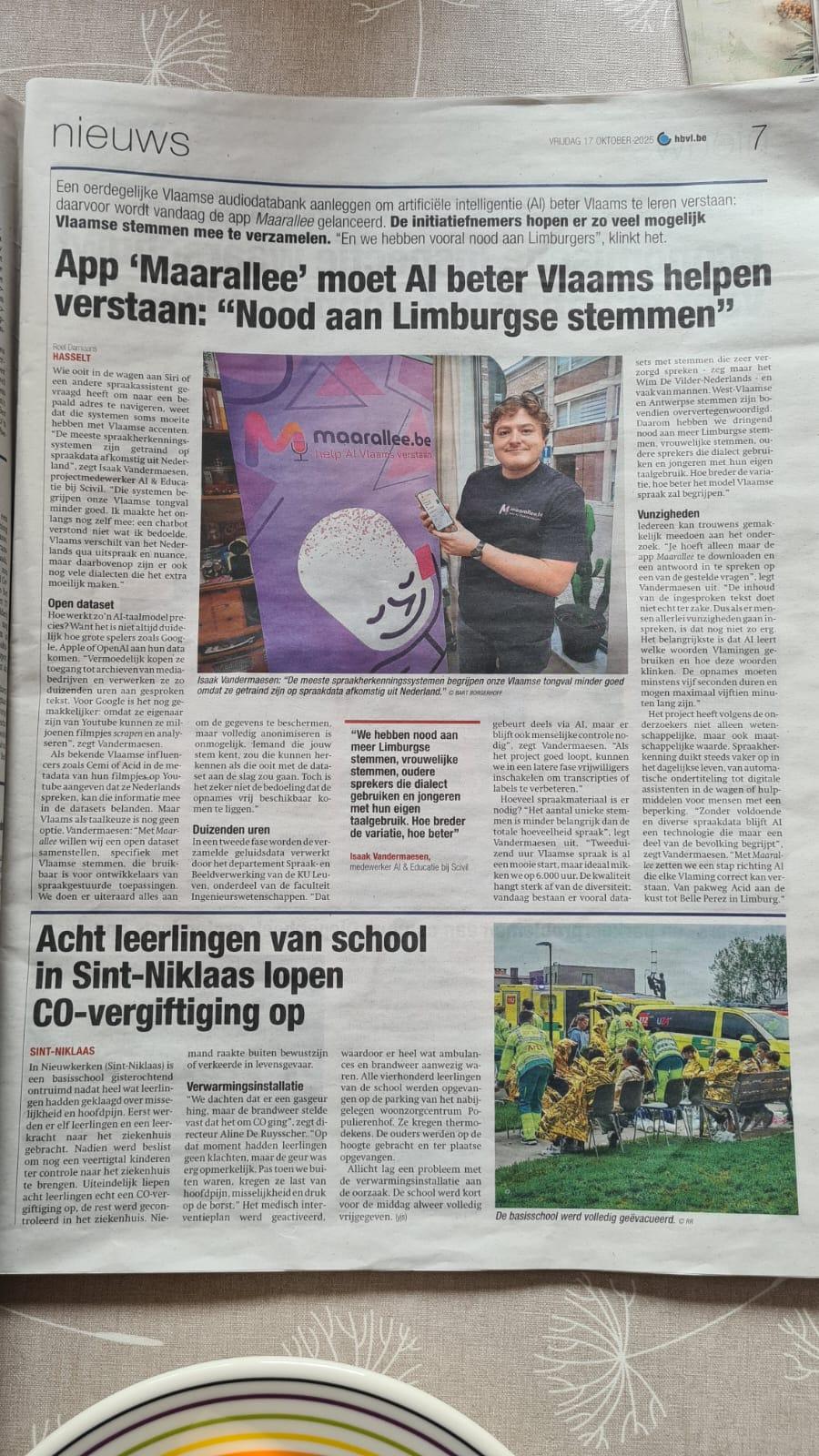
Newspaper article Maarallee. © Scivil
From a traditional campaign to a recognisable mascot
A good dataset obviously requires enough participants, but also a diverse range of participants. How did you try to reach them?
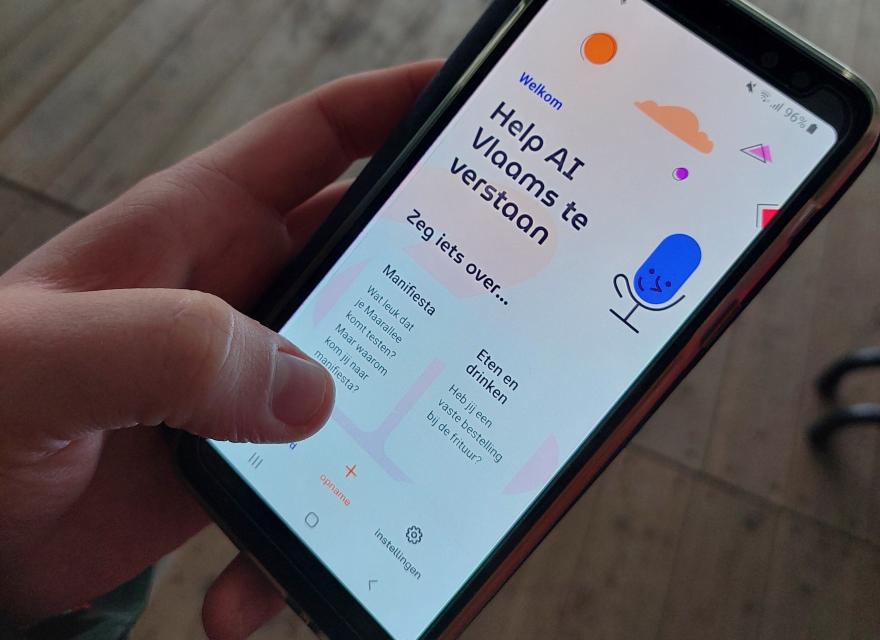
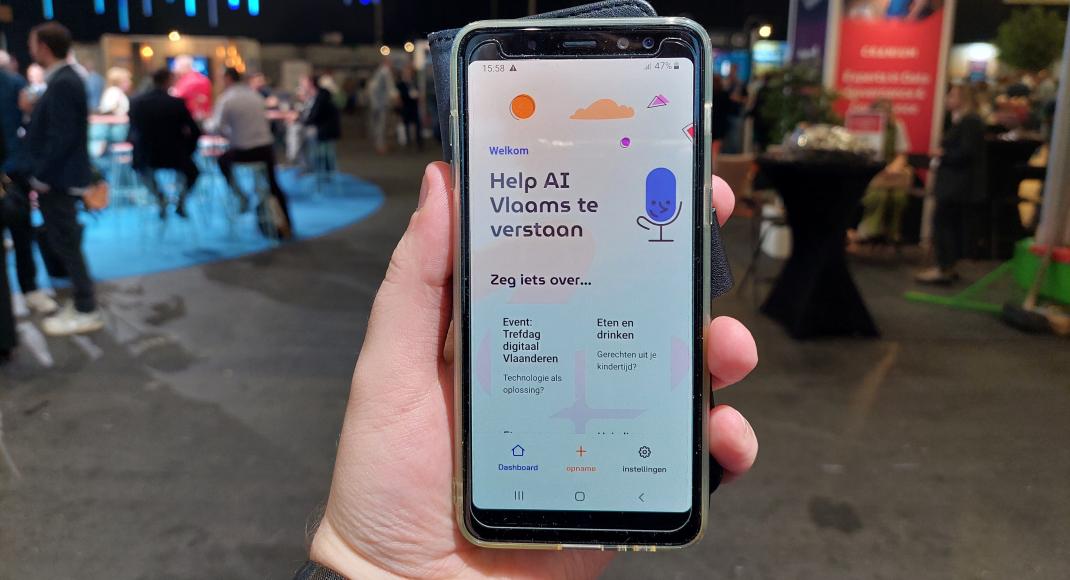
Isaak Vandermaesen: “We first looked for a way to collect lots of speech recordings quickly, in different locations at the same time, while allowing citizens to participate independently. In the end, we opted for an app that people could use on their smartphones. This allowed participants to make recordings whenever and wherever they felt comfortable doing so.
Our launch through traditional media also generated a lot of data from just one general press release. I think Maarallee’s sense of local and regional pride played an important part in that, both at a very local level, through regional dialects, and across Flanders as a whole. It is no coincidence that Maarallee attracted attention from newspapers such as Krant van West-Vlaanderen and Het Belang van Limburg.
Scivil also invests heavily in science communication and public outreach, which meant we could take Maarallee to numerous events and activities. We were present at Technopolis, FTI at Thomas More, Ekoli and Science Day, among others. Alongside our online campaigns, these events gave us plenty of opportunities to speak to people directly and encourage them to make their voices heard.”
Alyssa Lambrecht: “My role at Scivil focuses on social media, so with Maarallee I mainly tried to reach participants through different online channels. We created separate accounts on Instagram, Facebook and TikTok, allowing us to communicate extensively about Maarallee without overloading Scivil’s own channels.
Initially, we mainly used traditional graphics in the project’s visual identity, but they turned out to be a little dry. So we started making more videos and reels, with Isaak becoming something of a mascot. That playful, everyday style, with plenty of humour, suited Maarallee much better and prompted warmer responses.
We also experimented with advertising. The targeted campaign for the teaching pack was particularly successful. The main lesson I took from that is this: it is better to communicate in a targeted way than simply to post as much as possible. First think carefully about who you want to reach and how that target group wants to be approached.”
Experimenting to reach young people
Young people proved more difficult to reach. How did you try to get them involved in Maarallee?
Isaak Vandermaesen: “We tried several different things to move beyond the usual citizen science audiences and involve more young people. For example, we ran a competition on social media in which participants could win an air fryer. It had almost an immediate effect in helping us reach more students. Alongside our own social media channels, we also promoted the competition through student media such as Veto and Winagenda.
TikTok proved much more unpredictable. Because of the algorithm, it is very difficult to predict why or when a video will take off. Some of our videos from the early stages reached a very large audience, while later ones received far fewer views. In the end, education may have proved to be the easiest way to reach younger voices.”
Alyssa Lambrecht: “For me, the air fryer competition provided a particularly interesting insight. The competition was devised by students as part of the Science Communication course at KU Leuven. So it really was a competition for students, created by students. Afterwards, we also saw more recordings from this target group, which we had previously found more difficult to reach.
To me, that shows how valuable it is not just to try to reach your target group, but to involve them in thinking about how you can reach them.”
It is valuable not just to try to reach your target group, but to involve them in thinking about how you can reach them.
The classroom as a way to reach a hard-to-reach audience
Schools ultimately became an important way of reaching young people too. How did that collaboration develop?
Isaak Vandermaesen: “That collaboration is working very well now, although things got off to a slow start. The teaching pack was only ready in mid-April and initially hardly any teachers were using it. At the beginning of this school year, we therefore launched a new social media campaign, which generated a lot of enthusiastic responses. Since then, we have been in contact with many schools that are already using it or are planning to do so.
It is very motivating to see that each lesson generates almost twenty minutes of spoken data from young people under the age of 18, a group that we otherwise found very difficult to reach.
In terms of return on investment, collaboration with schools can therefore work extremely well, provided that your project takes teachers’ schedules and the learning objectives they need to meet into account. If you can seamlessly combine the two in a ready-to-use teaching pack, the return can be considerable.”
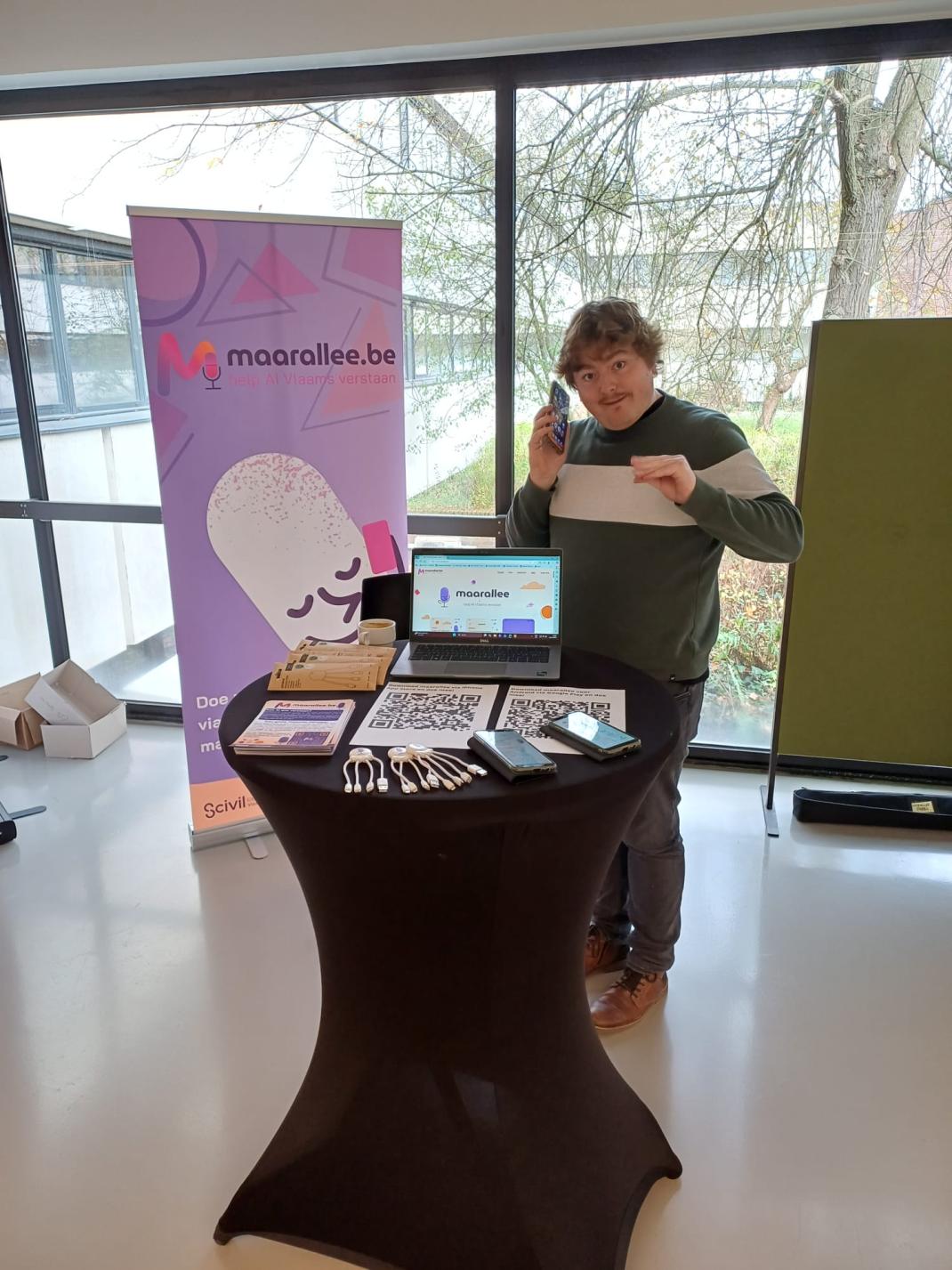
Isaak became the recognisable face of Maarallee. © Scivil
Being willing to change course
Looking back on all these different experiments, what did you learn yourselves?
Isaak Vandermaesen: “For me, this project taught me a great deal about perspective-taking and engagement. You can build an app exactly the way you want it or simply put a post online, but that doesn’t necessarily mean you are taking your target group into account. And with a brand-new project such as Maarallee, we first had to identify that audience.
By experimenting, meeting people and thinking about what might motivate the broad group of Flemish speakers to use our app, we were able to grow the Maarallee speech dataset.”
Alyssa Lambrecht: “You don’t need to post constantly if you start by thinking from the perspective of your target group: what would they enjoy? With limited time and resources, you are better off investing in a few strong ideas that really appeal to your audience.
We started with traditional, fairly dry graphics and quickly noticed that they didn’t quite work. So we changed course and dared to experiment, and discovered that targeted, human and playful communication worked better. And finally: don’t be afraid to have some fun with it.”
Building a dataset from scratch
What are you most proud of?
Isaak Vandermaesen: “I am particularly proud of the distinctive identity we gave Maarallee. The carte blanche we received from KU Leuven to shape the campaign meant that we could really explore how to motivate citizen scientists around a complex and new subject. For Scivil as both a knowledge and research centre, that was a particularly valuable experience. I am very proud of the end result: a fairly large dataset that we were able to build completely from scratch thanks to our hard work and the choices we made as a team. It also demonstrates the power of citizen science.
With additional resources for student workers, for example, we could probably have collected more data more quickly. But I think our broad campaign enabled us to build a much more diverse and representative dataset.”
Alyssa Lambrecht: “I am particularly proud of the videos we made with Isaak. They gave Maarallee a very distinctive, recognisable style online, and the responses were positive.
I am also pleased that we experimented with advertising and saw results from it. The targeted campaign for the teaching pack was particularly successful.”
From citizens’ voices to new speech technology
What ultimately happens to all the voices collected through Maarallee?
Isaak Vandermaesen: “The dataset will be distributed by the Dutch Language Institute as a corpus, a linguistic dataset. Researchers and start-ups will be able to request access to the dataset if they have a legitimate interest. They will then receive the appropriate licence to use the data in a privacy-friendly way.
This means participants’ contributions will continue to have an impact beyond Maarallee: the Flemish voices collected provide a foundation on which researchers and developers can continue to build speech technology that is better able to handle linguistic variation in Flemish.”
Interview and text: Sanne Strouven