Launch Webinar – Citizen Science in Belgium: Insights from the Citizen Science Scan 2025 - Scivil
minskyString.search.closeLabel
minskyString.search.triggerLabel
On 2 April 2026, from 12:00 to 13:00, Scivil presented the new Citizen Science Scan 2025 report during an online webinar. The session covered not only the key trends, figures and recommendations related to citizen science in Belgium, but also the story behind the citizen science scan itself. Anyone who would like to receive a printed copy of the report can indicate this in the form below, until 13 April 2026.
Short summary of the webinar
On 2 April 2026, Scivil launched its new Citizen Science Scan with a lunch webinar. In addition to presenting the results, we also explored the process behind the scan and our interpretation of the findings.
Jef explained how students spent four months searching online for citizen science projects. This process required substantial coordination among the team members working on the Scan. The team engaged in many discussions about what does or does not fall under our definition of citizen science, for example in the case of projects where citizen participation is largely limited to completing surveys. It was also not always easy to decide when an initiative should be counted as a separate project, or how to handle platforms that collect other projects. Throughout the entire process, the Scivil team aimed to make clear and consistent choices regarding all these questions. This is described in the methodology section of the report.
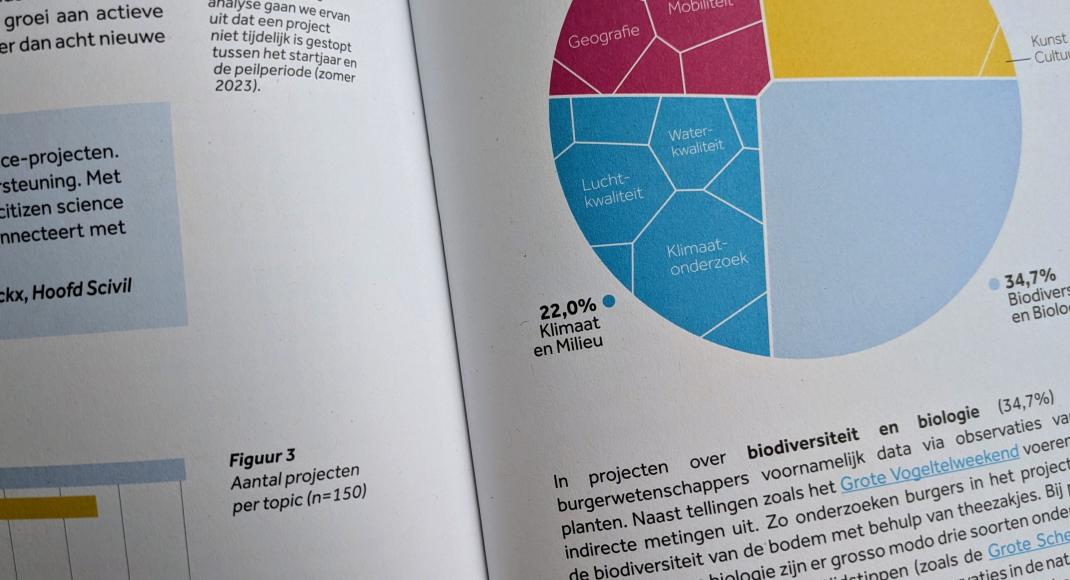
Karen then presented the main results of the Citizen Science Scan. The cluster ‘Biodiversity and Biology’ has further strengthened its leading position in Belgium’s citizen science landscape. Projects related to ‘Climate and Environment’ and ‘Human Behaviour and Wellbeing’ have seen an increase since the 2023 Scan. For this edition, we also introduced a new cluster: ‘Exact and Technical Sciences’, bringing together projects related to, for example, astronomy and Geographic Information Systems. In 2024, a remarkably high number of new projects were launched, and these projects also rely more frequently on European funding. Regarding the tasks carried out by citizens, we see an evolution compared to 2023: citizens are now more often involved in formulating research questions, helping to develop the research design, and contributing to communication and dissemination. Nevertheless, data collection remains by far the most common task performed by citizens in citizen science projects in Belgium.
After the presentation of the results, Caroline Michellier from UCLouvain – AfricaMuseum explored the differences between Dutch‑speaking and French‑speaking Belgium. The scan shows that Dutch remains the primary language of citizen science in Belgium, with 83% of projects available in Dutch. English is the second most common language (47%), and French takes third place (38%). For the 2025 Scan, Scivil made an extra effort to identify projects in French‑speaking Belgium through its collaboration with UCLouvain, but the share of French‑language projects did not increase compared with the 2023 Scan. In her presentation, Caroline argued for the need for a more centralised contact point for citizen science in French‑speaking Belgium, to ensure that projects can be more easily found, reach the wider public more quickly, and benefit from a stronger network for sharing experiences.
Annelies concluded with several key recommendations stemming from the Citizen Science Scan 2025. She advised involving citizens early and across multiple research phases, starting projects on a small scale and refining them through test pilots, and investing strongly in partnerships with local organisations and existing communities. She also highlighted new funding opportunities, including Horizon Europe, the importance of resources for communication, materials and quality assurance, and the need for sustainable internal support within research organisations as well as policy‑aligned win‑wins. Organisations can strengthen citizen science by providing contact points, internal funds, infrastructure and training, and by facilitating more exchange and collaboration, for example through working groups or Communities of Practice.
Programme
You can download the slides below.