Citizens prove North Sea climate change
"What is the state of our North Sea? Are there no more or fewer jellyfish now than, say, fifty years ago?" Until recently, scientists could only partially answer these questions, because there was little or no reliable long-term data available to make statements about trends. The beach observation network SeaWatch-B solves this shortcoming with a scientifically sound measuring program. We spoke with initiator Jan Seys, head of science communication and spokesperson for the Flanders Marine Institute (VLIZ) and with four enthusiastic SeaWatchers, who each meticulously measure, observe and identify a part of our coastal strip.
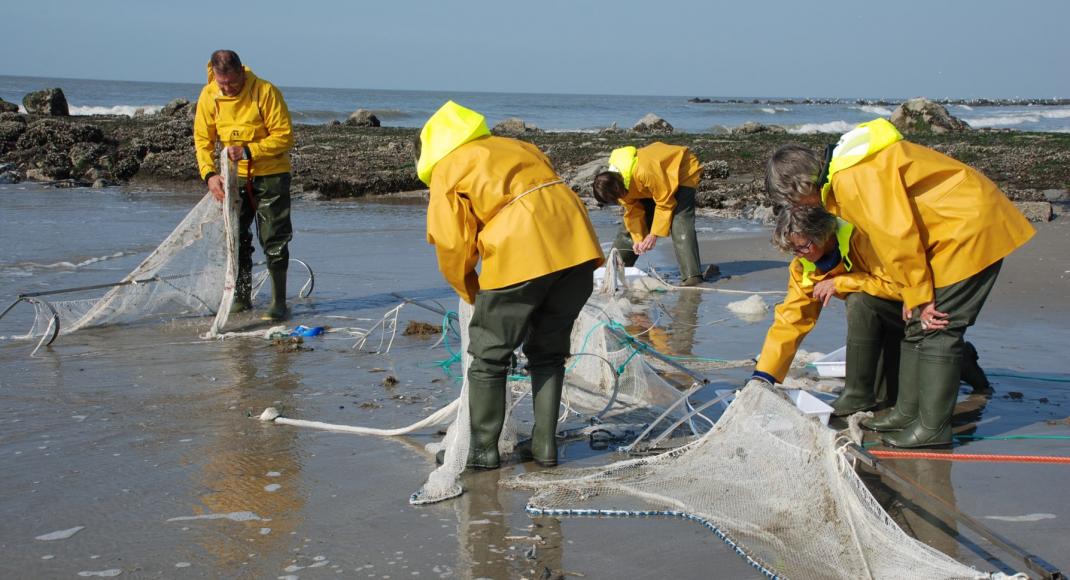
VLIZ launched the citizen science project SeaWatch-B in 2014. A limited group of citizens received training and the necessary equipment. They are currently still carrying out a set of measurements on a specific beach section. Ten indicators are given special attention: 'beach occurrence', 'people/dogs/horses on the beach', 'scale horns on piers', 'cruising catches', 'sea water temperature', 'sandworms', 'washed up jellyfish', 'shells', ' waste' and 'archaeological finds'. By monitoring these parameters in a standardized manner, they trace natural or human changes in our North Sea and on our beaches. The citizen science initiative is supported by the Flemish arm of the European LifeWatch, a project that facilitates research into biodiversity and ecosystems.
Monitoring beaches and coastal waters
What was VLIZ's motivation to start a project like SeaWatch?
Jan Seys (VLIZ): You could say that we identified a gap. Scientific research into the ecosystem of our beaches and shallow coastal waters has been too fragmentary. There was no long-term monitoring and therefore no scientifically sound conclusions could be drawn. In the citizen science project SeaWatch, we applied three basic principles from the start: the measurement program had to contain different measurement facets, the measurements had to be made according to standardized, strict scientific procedures and the project had to remain feasible for both citizens and scientists.
It is truly heartwarming to see our SeaWatchers evolve into true experts.
Have you achieved that feasibility?
Jan Seys (VLIZ): Definitely! The citizens or SeaWatchers are now involved for a sustained effort of 4 days of fieldwork per year. There are of course extras on top of that, such as following training courses, preparing and taking care of the material, uploading the photos, and writing a report. The training courses are a crucial factor, we tailor them to the needs of our SeaWatchers. What do they need most, is it identifying fish such as flounder, plaice, turbot and brill or recognizing shells or crabs? It is truly heartwarming to see our SeaWatchers evolve into true experts. A number of them move on to our beach work group or they are experts on our 'Grote Schelpenteldag' (Great Shell Counting Day). But we may be able to let them speak for themselves as far as feasibility is concerned!
Paul Vanhaecke (section Bredene): As far as I'm concerned, in terms of fieldwork and reporting, I work on the project one day per quarter, for the additional training and activities I also count on a number of evenings per year.
Mia Quartier (section Westend): Those additional trainings are very concrete and to the point, often on the beach. They strenghten my knowledge and motivation. SeaWatching has become a nice hobby for me, an engagements as a player in an inspiring team.
Solange Coppens (section Middelkerke): In my case you can even speak of a fascinating passion, one that takes up all my spare time! As a nature guide, a second stay by the sea brought me to a biotope that I did not know and that I wanted to learn more about. I plan my measurements together with 2 colleague nature guides from Ghent, in function of the time of the tide and the wind force. In winter, low tide often connects with darkness and at more than 4 Beaufort, wading through the water and taking samples becomes more difficult and more dangerous. I start the day before with checking the material. On the day itself, the measurement is limited to 3 hours on the beach, but we check determinations, fill in the field form, sort the photos and send them in. Afterwards we check the material and store it. For example, I hang the net to dry and I clean it thoroughly because there are often still algae and very occasionally also small organisms (shrimp, fish, anemone…).
Less North Sea shrimp, more exotics
The project started in 2014, what observations has VLIZ been able to make about the North Sea thanks to the SeaWatchers?
Jan Seys (VLIZ): Our first SeaWatch-B report 'How is the North Sea doing?' (in Dutch, 'Hoe is de Noordzee eraan toe'), which we based on data from 2014 to 2018, shows that the Belgian North Sea is undergoing a significant human impact, primarily the effects of climate change. Cold-water species such as the North Sea shrimp are decreasing in number compared to similar studies from 20 years ago, while warm-water fauna such as the venomous lesser weever, the lesser hermit crab and certain exotics (American comb jelly) are increasing in number. The North Sea has also warmed by 1.7°C over the past half century, or twice as fast as the global average for ocean and seas. This is reflected in all kinds of shifts in the food chain, the most important of which is the migration of cold-water species and an increase in animals and plants from the Atlantic Ocean or further south. There is also good news. North Sea water contains less polluting metals and oil, and purple snails appear to have rediscovered our coast after an absence of thirty years. The strength of our citizen science project lies mainly in the sustained effort over the seasons and years and that is what our SeaWatchers guarantee, they are often the first to discover certain trends.
Paul Vanhaecke (section Bredene): What is striking is that the seasons play a significant role. We as SeaWatchers can very clearly define the shrimp season.
Mia Quartier (section Westend): The diversity of life in our North Sea surprises me enormously.
Katrien Vervaele (section Blankenberge): That was the immediate trigger for me to get into the project, to learn more about marine biodiversity. Every measurement is simply a feast, I think I have seen more and more living shells since 2015, and the pioneer plants that form dunes also fascinate me.
Solange Coppens (section Middelkerke): We make new discoveries with every SeaWatch measurement. During the last measurement in February 2022, for the first time I had 2 green jelly-like balls in the net with the size of a grape, they turned out to be eggs of the dotted Phyllodoce maculata!
The strength of our citizen science project lies mainly in the sustained effort over the seasons and years and that is what our SeaWatchers guarantee, they are often the first to discover certain trends.
The shell counting story
The general public is aware of the annual Great Shell Counting Day (Grote Schelpenteldag). This is a larger-scale VLIZ initiative with a different focus?
Jan Seys (VLIZ): The number of volunteers that we can deploy for the intensive SeaWatch program is limited, while many citizens would still like to help. That is why, together with Eos and Natuurpunt, we looked for an action that pays attention to the story of marine biodiversity. For example, five years ago we started the Great Shell Counting Day (Grote Schelpenteldag), the collection and identification of shells by the general public on one specific day in the spring. That day is also relevant for our marine biologists, because unfortunately scientists did not know what the top 5 shells on our beaches were until recently. The counting day was therefore a bull's eye for scientists and citizens alike. In all, 200,000 shells were counted and identified during the past five editions. In the last edition alone, there were 60,000 (38,000 in Belgium, 22,000 in the Netherlands) thanks to the beautiful weather. The Netherlands has now participated for the first time, thanks to Naturalis as the initiator, and they are also enthusiastic about the results. Next year we also hope to include the Zeeland coast and the northern French coast in our shell counting story. In this way we hope that support for healthy seas and oceans will increase. In May, together with Scivil, Eos and Natuurpunt, we are again planning a day on which our measurements and biodiversity on our coast will be central. Under the 'Zeekerweten' flag, experts will be available at thirty places to explain to citizens how they science and who knows how to warm up a new generation of Seawatchers.
Irreplaceable
What is the most important added value of citizen science for VLIZ and for you?
Jan Seys (VLIZ): Citizen science is not new, even in the 1950s and 1960s there were seasoned volunteers, amateurs as it were, who made observations and passed them on to scientists. However, there have been a number of revolutions: the approach, attention and support are now broader. In addition, new technology, such as artificial intelligence, ensures that large-scale data processing can be done more efficiently. Apps like ObsIdentify are phenomenal in that regard. In general, you can safely say that the original suspicion of some scientists about the involvement of citizens in scientific research has disappeared. Many of our Seawatchers determine better than the average biologist, their scientific attitude is very high. In short, the efforts of citizens as citizen scientists are very valuable and almost impossible to replace.
Interview and text: Hilde Devoghel (Tales and Talks)