FlowerPower for more biodiversity
Last year, 492 gardeners laid out three test plots in their garden to investigate how we can transform our lawns into a more biodiverse and colorful grassland. We interviewed three initiators of the ambitious citizen science project 'FlowerPower de Tuin' 'FlowerPower the Garden' at Hogeschool Gent. Stephanie Schelfhout did her doctorate on flowery grasslands and wrote the project plan for FlowerPower together with her supervisor An De Schrijver. Jorunn Dieleman is a paleoclimatologist with a passion for science communication. Freek Van Baelen is a researcher and lecturer in market research.
What is the goal of 'FlowerPower de Tuin'?
Jorunn Dieleman: Twelve percent of the soil surface in Flanders is occupied by private and public gardens. That is more than the total forest area. All our gardens together therefore contain an enormous nature potential. If we make our gardens more biodiverse, we make the whole of Flanders more biodiverse.
Stephanie Schelfhout: While our wild nature is scattered in nature reserves, our gardens form a continuous green network of enormous value. For example, some wild bee species only fly 200 to 300 meters. So they cannot forage on flowers that are a few kilometers away, but can be helped with the flowers in a neighboring garden.
Freek Van Baelen: A flowery grassland in every garden can therefore make a big difference, but the Flemish tend to stick to a neatly mowed lawn. With our project, we want to adjust that mowing mentality and demonstrate that a flowery grassland can fit just as nicely into a garden as a mowed lawn.
You asked Flemish people about their gardens. They are not just willing to give up their grass carpet?
Freek Van Baelen: Indeed, our marketing students interviewed 1700 people on the street about what they use their gardens for and how they maintain them. Based on the results, we could distinguish five types of gardeners: the 'barbecuers' are the largest group with 31%, followed by the 'green thumbs' with 20%, the 'hammock hangers' with 19%, 15% are 'hobby gardeners' and another 15% we labeled as 'proud gardeners'. All these groups, except for the 'green thumbs', attach great importance to a neatly mown lawn and are not immediately to be found in favor of a flower meadow.
There are many unjustified prejudices about such a flowery grassland. People think it provokes hay fever, attracts stinging insects and requires a lot of work to maintain. But that's all wrong. Many gardeners find such a flower meadow less attractive than a lawn. They think it looks messy. There is no accounting for taste, but in our opinion such a flower meadow can bring a nice element of relief and color into your garden. The perfect addition to your lawn.
We ask quite a lot of our citizen scientists. Not only do they give up 7m² of their garden to an experiment, they also put a lot of time and energy into all the observations and counts we ask them to do.
Jorunn Dieleman: The 'green thumbs' are most enthusiastic about the idea of a carpet of flowers in their garden, yet a relatively large number of respondents in this group also indicate that they occasionally fertilize their grass or even use pesticides. It may sound strange, but a flowery grassland benefits most from a poor soil. In soil with a lot of nutrients, fast-growing grasses literally overshadow the flowers.
How does the FlowerPower project work? What do you ask the 492 citizen scientists?
Stephanie Schelfhout: We ask quite a lot of our citizen scientists. Not only do they give up 7m² of their garden to an experiment, they also put a lot of time and energy into all the observations and counts we ask them to do.
It started in February (2022) with completing a questionnaire, taking a soil sample and demarcating and constructing three test areas of 1.5 m by 1.5 m each. The laying method differs on each of the test plots: on trial plot A nothing had to be done, trial plot B was sown with a native flower mixture and in trial plot C the sod was first removed, then the same native flower mixture was sown. All test plots are mowed twice a year.
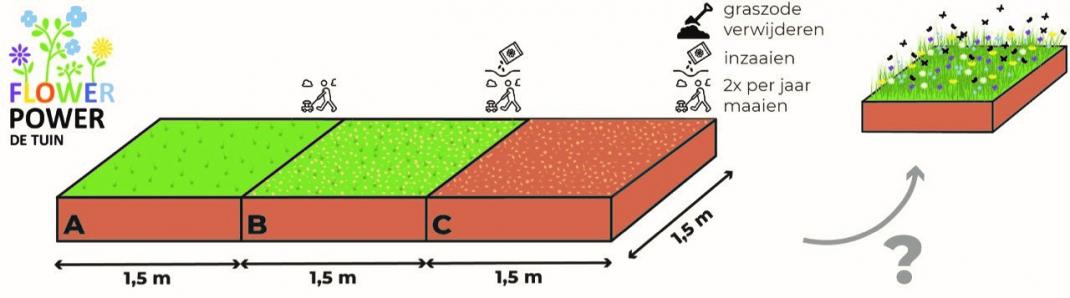
The observations started in June, when the citizen scientists counted and identified flowers in each plot using ObsIdentify. They also counted the insects that landed on flowers in the test areas for ten minutes in the same way. At the end of the month, the height of the vegetation was measured, then the test areas were mowed and the clippings were removed.
In August, the participants could optionally perform these counts again. Despite the timing - it was the summer vacation - we still received about eighty measurements. At the end of September, we completed the cycle for that year with a second cut. We also continuously asked to take and forward photos of the test areas.
A close-knit community is forming around the project. The citizen scientists share results and tips on our internal Facebook group, they meet each other at our FlowerPower cafés or hear scientific results and garden tips in our podcasts.
That does indeed sound quite labour-intensive. Do you notice a dropout among the participants? Does the enthusiasm gradually decrease?
Jorunn Dieleman: No, the commitment remains very high. This may be partly explained by the fact that we built in a kind of threshold in the first step. Of the 1300 enthusiasts who registered, 492 took the trouble to mark out the test areas, send a photo and complete the questionnaire. In that first step, we immediately asked a lot of the volunteers. This ensured that those who took this step were really prepared to fully participate in our project.
Stephanie Schelfhout: The citizen scientists were very curious about the results of the soil analysis of their gardens. They were really waiting for that. We just shared the results with them, so now we just hope they stay on board for the rest of the study!
Jorunn Dieleman: A close-knit community is forming around the project. The citizen scientists share results and tips on our internal Facebook group, they meet each other at our FlowerPower cafés or hear scientific results and garden tips in our podcasts.
2022 was een erg droog jaar. Dat had ook z'n weerslag op onze tuinen, leerden we al van CurieuzeNeuzen in de Tuin. Bracht de droogte een extra uitdaging met zich mee?
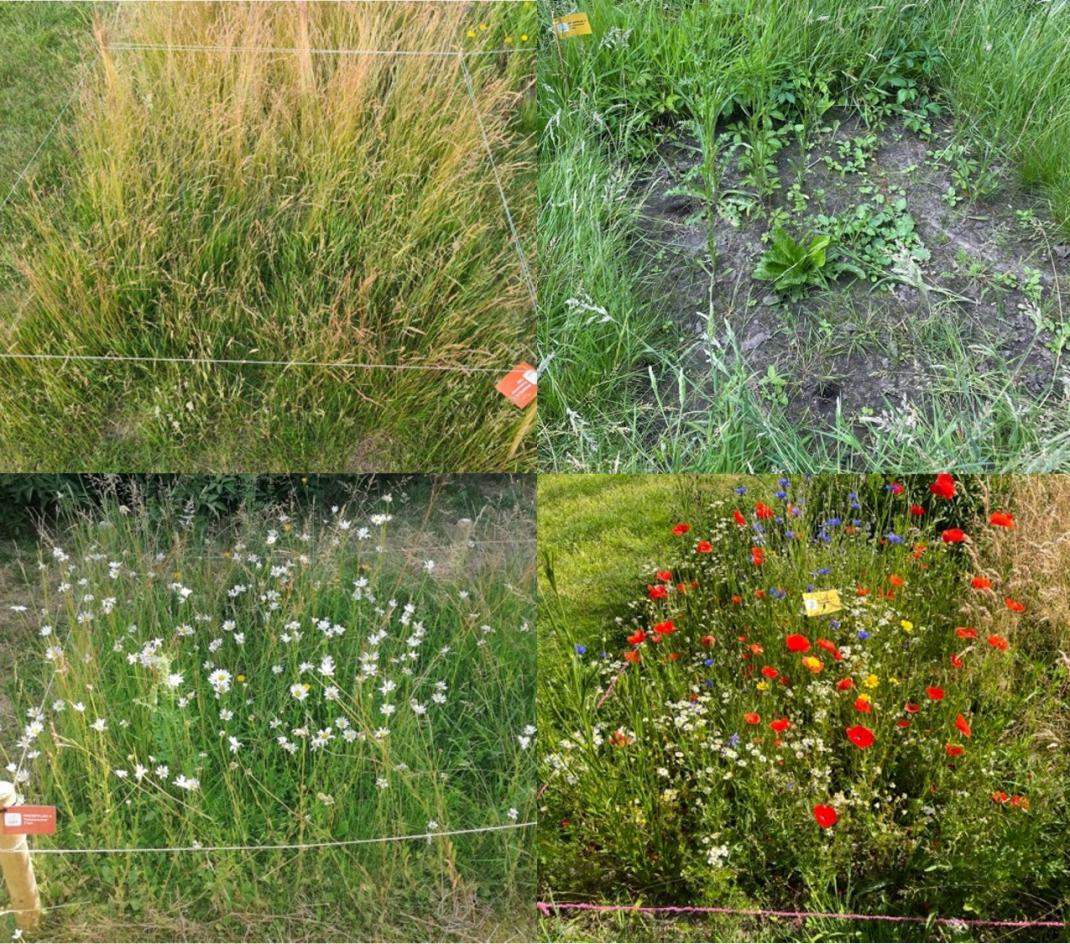
Stephanie Schelfhout: Absoluut! Bij maar liefst een kwart van de deelnemende tuinen groeide geen enkele bloem in proefvlakjes A en B. Bij een tiende groeiden ze zelfs niet in proefvlakje C. De teleurstelling bij de burgerwetenschappers was dan ook groot als er weinig tot geen bloemen te voorschijn kwamen. Die beperkte opbrengst was zeker niet alleen aan de droogte te wijten. Onze tuinbodems zijn gewoon overbemest, waardoor snelgroeiende grassoorten er domineren en het licht wegnemen voor alle andere soorten die er willen groeien. Maar ook 'nul bloemen' is een belangrijk wetenschappelijk resultaat. Gelukkig konden we de burgerwetenschappers overtuigen van het belang van het doorgeven van die nulmetingen.
Jorunn Dieleman: Heldere, eenduidige communicatie blijft ook een uitdaging. In het begin van de droogte, vlak na het inzaaien, overwogen we de vraag van enkele burgerwetenschappers om de proefvlakjes water te geven. Dat was misschien beter geweest voor de wetenschappelijke resultaten, maar we besloten uiteindelijk om dat niet te doen. We vonden geen eenduidige manier om iedereen op dezelfde manier te laten water geven, waardoor we verwarring hadden kunnen zaaien. Toen we zagen dat de droogte bleef aanhouden, waren we erg blij met onze keuze. Door onduidelijke communicatie hierover hadden we nog meer schade kunnen aanrichten dan de droogte al deed. We stuurden de burgers dit najaar nieuwe zaden op om proefvlakjes B en C opnieuw in te zaaien en zo de effecten van het droge 2022 een beetje te neutraliseren.
Freek Van Baelen: Wat mij verbaast aan FlowerPower is de complexiteit van het project. Alle elementen zijn zo sterk met elkaar verweven: bodemgesteldheid, droogte, timing... al die nuances op een heldere manier naar buiten brengen, is echt niet gemakkelijk. Ook de nauwe samenwerking met allerlei partners zorgt ervoor dat een klein projectteam toch heel veel ballen in de lucht moet houden.
'FlowerPower de Tuin' does indeed involve a large group of partners and stakeholders. How is the collaboration going?
Stephanie Schelfhout: Er is in Vlaanderen een kleine, maar heel gedreven groep bezig met tuinenonderzoek. Er is veel bereidheid tot samenwerking omdat we allemaal het gevoel hebben aan hetzelfde zeel te trekken. CurieuzeNeuzen in de Tuin is bijvoorbeeld een echte inspiratie voor ons. Dat niet alleen, we konden hun protocol en zelfs de staalbuisjes voor bodemstaalname gewoon overnemen.
There is a small, but very passionate group in Flanders involved in garden research. There is a lot of willingness to cooperate because we all feel we working towards the same goal. 'CurieuzeNeuzen in de Tuin' (Curious Noses in the Garden), for example, is a real inspiration to us. Not only that, we could simply adopt their protocol and even the sample tubes for soil sampling.
Jorunn Dieleman: We can also ride the wave of Mijn Tuinlab and ObsIdentify. We collect our data through these platforms.
Stephanie Schelfhout: The nature education domain De Helix also helps us to develop lesson packages for secondary schools. In the meantime, we also collaborate with Goodplanet in their project 'Een hart voor bijen' (A heart for bees). In it they develop teaching packages for primary schools, among others.
Freek Van Baelen: There is a very fruitful collaboration with Knack as a result of 'Maai Mei Niet' (Don't Mow May). 'Maai Mei Niet' creates a very broad awareness of the value of biodiversity in our gardens. You can see that the campaign is reaching more gardens year after year. FlowerPower de Tuin is the logical stepping stone for some gardeners who would like to learn or contribute more.