Inclusion for Neurodivergence
'In the rush to gather data for a citizen science or research project, researchers may forget to adopt an open and communicative attitude towards their participants. But when this is considered in advance, the rush for data and participants might, in the long run, feel less like a rush at all.' So says Eleonora Tilkin-Franssens, practice-based researcher and lecturer at UCLL (Inclusive Society, SRW) and AP University of Applied Sciences (People & Society, TP), who also holds several other roles. She represents the autism community in various research projects and, as a former teacher, eventually found her way into the research world, where she now helps to co-creatively address the challenges of inclusive recruitment and engagement of neurodivergent participants. Her research and recommendations, however, are so universal and practical that they are relevant to every scientific project.
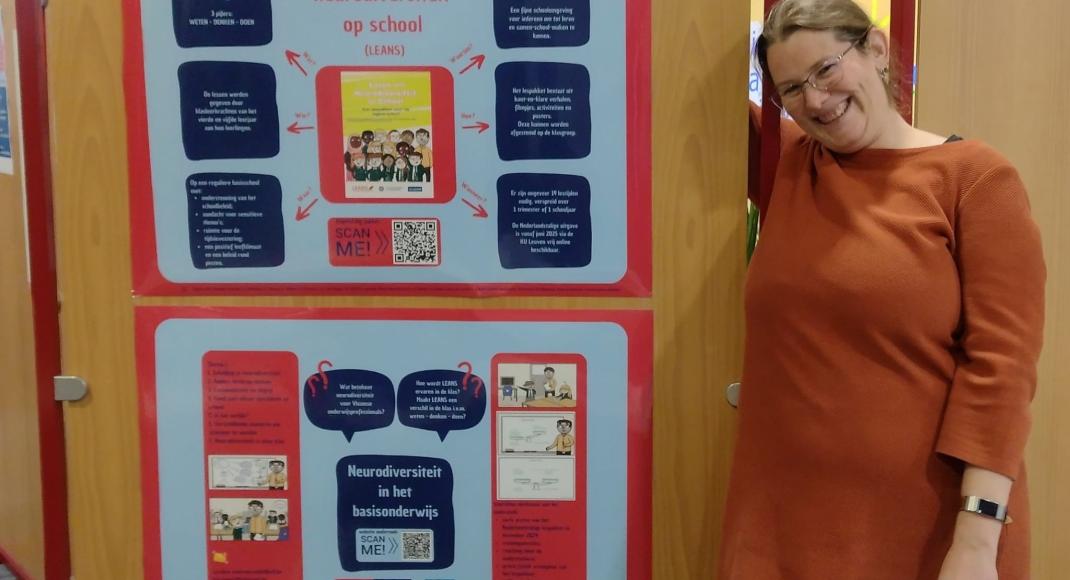
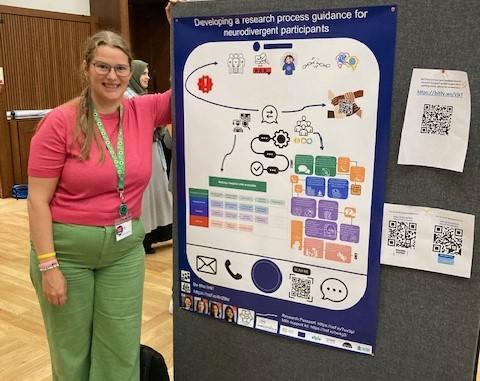
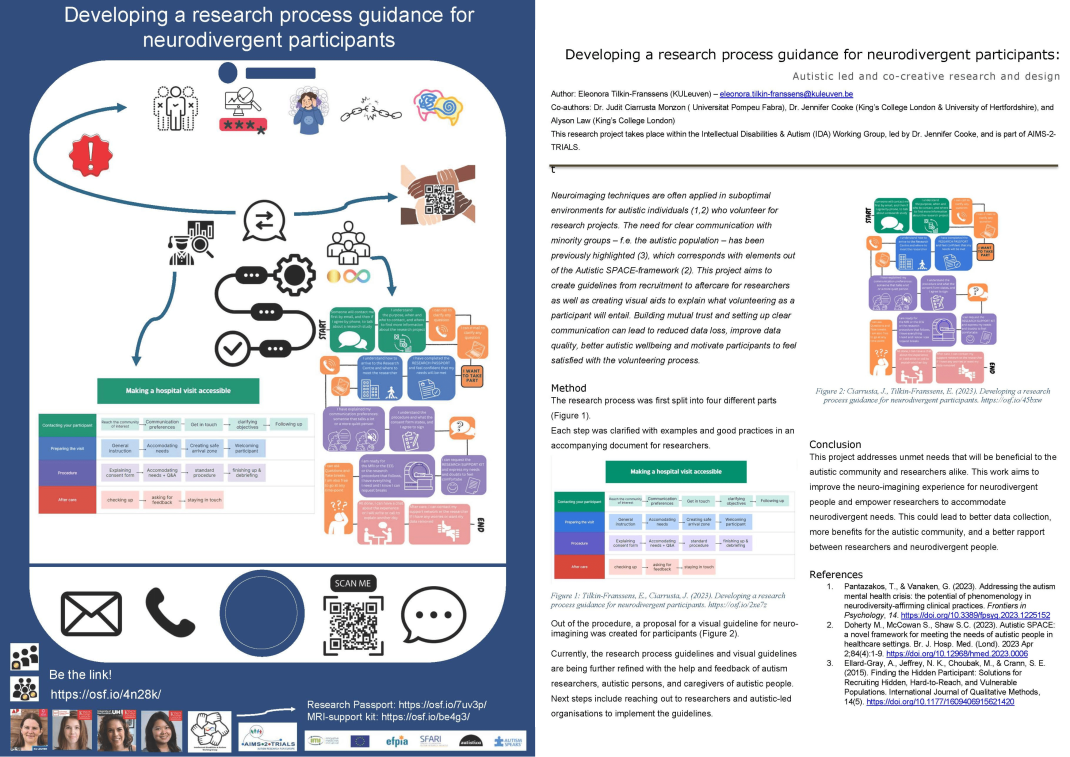
‘Developing a research process guidance for neurodivergent participants’ is the title of the design created by Eleonora together with colleague Dr Judit Ciarrusta Monzon and the IDA working group within AIMS-II trials. You can rewatch Eleonora’s pitch during the 2024 Respect4Neurodevelopment event. In this project, they zoom in on the importance of neurodivergent participants in scientific research and how the approach can be tailored to these profiles. In this context, they also attempt to give language to the neurodiversity movement, which focuses on differences in needs, experiences and ways of being. Those who would like to know more about neurodiversity can take a look at the LEANS teaching package for upper primary school pupils. LEANS is currently being piloted in Flemish primary schools as part of a joint research project by UCLL (Inclusive Society and Education & Development) and KU Leuven (Research Group Autism of Orthopedagogy).
Safety
How can researchers adapt to a neurodivergent participant field? What are the basic principles?
Eleonora Tilkin-Franssens: 'It is not so much about rules, but rather about a flow to start a conversation with minority groups, such as the autism community, in order to align with their communication preferences, research preferences and needs. In my opinion, this allows you to recruit participants from a broad intersectionality, offer them a safe research environment, and consequently your data becomes much more qualitative and valuable.
A first tip is to contact the advocacy organisations and engage in dialogue with them. For the autism community in Flanders, these are for example VVA (Flemish Association for Autism) and LAVA (Reading and Advisory Group of Adults with Autism) vzw.'
Clear and thoughtful communication is key?
Eleonora Tilkin-Franssens: 'Indeed, every neurodivergent minority group and every individual has different needs from an intersectional perspective. With clear communication and alignment with your participants, you can already address many shared needs.
This could include: how someone is welcomed; structuring and going through the course of the research together; discussing how someone can request a break; whether the research is aimed at the needs of the advocacy organisation and can have a positive societal impact; how data is stored; providing a route plan; building in predictability where necessary; and so on. Not everyone needs these universal adjustments to the same extent, but providing them harms no one.
Another example is that a researcher often says they are ‘always available’. But what does the researcher actually mean by that? When are they available and how long does it usually take to get a response? How and when should you send a reminder? By coordinating this in advance and clearly indicating what is desirable, you can manage expectations, avoid overly insistent contacts or participants dropping out, and have a happier group of participants.
Communication is an underestimated factor that researchers often do not think about proactively. With neurodivergent participants, this can make a big difference in their stress levels and whether they manage to take part in all research activities. Participants who feel good and safe generally give fewer socially desirable answers and feel more motivated to complete all research activities. This can also make a difference in the diversity of the subgroups within your research population, resulting in richer and more varied data.'
Communication is an underestimated factor that researchers often do not think about proactively. With neurodivergent participants, this can make a big difference in their stress levels and whether they manage to take part in all research activities.
Active listening
What is central to aligning with advocacy groups and participants?
Eleonora Tilkin-Franssens: 'For me, it is an open, actively listening attitude in which you do not make assumptions for the other person and non-judgementally seek out their needs. I assume that an advocacy group is open to exploring what their members require in order to be able to participate in research. The Mosaic toolkit to end stigma and discrimination in mental health by the WHO is, in this respect, a useful tool to proactively reflect on communication and protocols in your research project. Working together in an intersectional way, creating a strong exchange between researchers and advocacy groups, and building on this, that is essential.'
Beyond shame and stigma
Are there perhaps projects where such an inclusive approach is even more important?
Eleonora Tilkin-Franssens: 'That’s correct. In a citizen science project such as counting butterflies or measuring air quality in a School Street, this is not so crucial. Although even there, it is advisable to roll out a detailed communicative step-by-step plan for all participants, with feedback messages and friendly reminders to, for example, check the rain gauge again before the deadline.
But when it comes to, for example, recording the impact of environmental noise on a family, it is a very different story. This is often overlooked. Beyond shame and stigma, proactively addressing needs, communication and mutual trust becomes very important. Perceived meta-stigma and feelings of unsafety influence not only the well-being of your participants but also how you as a researcher are seen by a community, as well as the quality of your data.'
What are your plans for the future?
Eleonora Tilkin-Franssens: 'Next year we will start a participatory and co-creative research project at AP University of Applied Sciences and Arts (knowledge centres ‘People & Society’ and ‘Research into Lifelong Learning & Innovation’) together with the Academic Workplace Autism, focusing on the transition between Higher Education and the labour market for students with (suspected) autism. Our aim is to create a transition plan based on Universal Design for Transition. In this, we will use, among other things, the Mosaic toolkit to bring all stakeholder groups together. If you know that the majority of scientific research on autism focuses on the causes of autism rather than on the support needs of autistic people or on how our society can be organised more equitably, you realise there is still a long way to go.
As a research participant myself, I have experienced barriers and have always entered into constructive dialogue with the researcher about this, so I am very aware of how important it is to facilitate participation in scientific research for neurodivergent participants without passing judgement. So here is a warm invitation to the world of citizen science to engage in dialogue.'
Interview and editorial work by Sanne Strouven