Snapshots of the Fair
Bart G. Moens is a historian and doctoral researcher at the Antwerp Research Institute for the Arts, affiliated with the University of Antwerp. He is involved in the European SciFair project, which researches science popularization at nineteenth-century fairs. For this research, the team is seeking photos of fairs from this period. This spring, they launched a call to share old "Snapshots of the Fair" (in Dutch: Kiekjes van de Kermis) with them.
Looking for a needle in a haystack
Why are you searching for there photos?
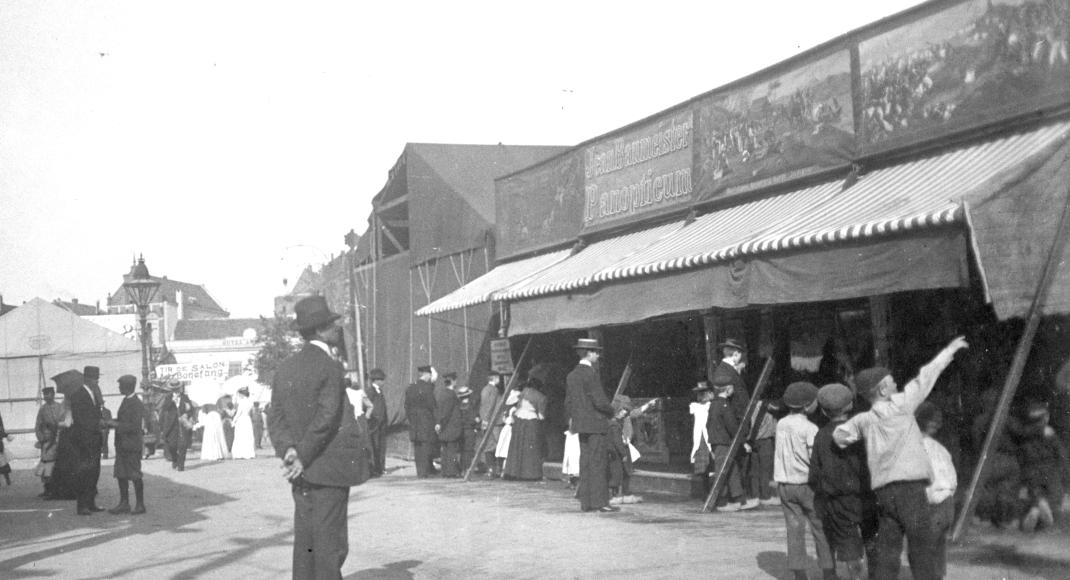
Bart Moens: “Images of fairs from before World War I are quite rare. We occasionally find them in city archives, on posters, postcards, or in advertisements and reports in newspapers. Now we’re primarily searching for more candid photos taken by fair visitors. These provide a different perspective on the fair, offering additional insights into which attractions were there and what they looked like, as well as about the visitors themselves: how many were there? How were they dressed, and how did they behave?
It sometimes feels like looking for a needle in a haystack to find these kinds of photos. Today, we almost all have a camera ready on our smartphones, but 150 years ago, of course, things were very different—amateur photographers were quite rare. Moreover, their photos are usually not in public archives but rather in private collections or tucked away in people’s attics. Unfortunately, not many people still have family photos from before World War I. It’s a big challenge, but since these photos can give us a unique glimpse into the fairs of that time, they’re real treasures when we find them.”
We spoke with a 93-year-old grandmother who shared wonderful stories with us. Not only did she tell us about her own childhood, but she also passed on stories she knew from her parents and grandparents. These are fantastic sources of information that we wouldn’t find anywhere else.
Was that why it was important to launch a broad call?
Bart Moens: “Yes, exactly. We're trying to reach as wide an audience as possible. Anyone with an old photo of a fair can share it on our website. For those who need help digitising or uploading their photos, we’re more than happy to lend a hand.
An important target group for our project is the fairground families themselves, who often have been in the fair world for generations. Initially, the distance between us as academic researchers and them was quite large. But they are rightly very proud of their craft and place great value on their history. That shared passion has brought us closer. Step by step, we’re building trust, allowing us to uncover precious knowledge and stories. For instance, not long ago, we conducted interviews with a fairground family from Charleroi. There, we spoke with a 93-year-old grandmother who shared remarkable stories - not only about her own youth but also about the lives of her parents and grandparents. These are incredible sources of information that we wouldn’t encounter otherwise.”
Full circle
What did the fair look like 150 years ago?
Bart Moens: “At first glance, not so very different from today. It was also a vibrant collection of stalls offering games, food, and drink, such as shooting galleries and stalls selling doughnuts. Speaking of doughnuts, they first appeared at fairs in our region in the nineteenth century. You’ll notice that many of today’s fairground stalls explicitly reference their long tradition in making them. However, there were also mechanical attractions, thanks to the significant technological advancements of that era, such as steam carousels.
What was different compared to now is that fairs used to play a major role in popularising knowledge and technology. One hundred to one hundred and fifty years ago, information circulated much more slowly than it does today. There was very little visual communication, and people were generally less educated. Travelling attractions at local fairs shared knowledge about geography, history, current affairs, and scientific developments. They did this through spectacular shows and images, such as large panoramic depictions of distant countries or historical battles. Additionally, anatomical museums travelled around, explaining the workings of the human body and medical advances. And of course, many people were introduced to new technologies like photography and cinema for the first time.”
Fairs used to play a significant role in popularising knowledge and technology. Travelling attractions at local fairs shared information about geography, history, current affairs, and scientific developments.
This spring, you and the 'Kiekjesteam' were present at the Sinksenfoor to generate attention for your call. How did you end up there?
Bart Moens: “That was the idea of our project's communication partner, Julie De Smedt (wetenschapscommunicator.be). She encourages us to link our research to current events to generate public interest. That’s how we ended up at the Sinksenfoor. During the opening weekend, we set up a large LED screen displaying images of the fair from 150 years ago. We provided some background on fairs of the past, which gave us the opportunity to spread our call. We had reprinted old postcards of the fair and added information about our project on the back. We handed out quite a few that day. I secretly feared we would find some trampled on the ground while cleaning up a few metres away, but that wasn’t the case! People apparently really appreciated them as souvenirs.
There was a lot of interest in our research. The postcards and the screen worked well as conversation starters. People became curious and naturally began asking questions and sharing memories. But perhaps what I found most wonderful was that, in a way, we came full circle. One hundred and fifty years ago, fairs played an important role in popularising and communicating science. Now, we were presenting our own scientific research on the fairs of that time back at the fair.”