Citizen Science Networking Day 2026 - Scivil
minskyString.search.closeLabel
minskyString.search.triggerLabel
On Monday, 28 September 2026, Scivil will host its next Citizen Science Network Day at Aeropolis in Brussels (near the Schaerbeek trainstation), in collaboration with Beweging.net, VITO and the VUB Citizen Science Contactpunt. Expect an inspiring keynote by dr. Dilek Fraisl, a series of engaging talks and in-depth workshops on various aspects of citizen science, as well as a pleasant networking lunch. Discover the programme below.
We offer a wide range of engaging citizen science sessions on topics such as effective communication, inclusion and diversity, how to get started with citizen science, and practical examples from citizen science in the city, biodiversity and environment, the heritage sector, and the Global South. This edition also places a strong focus on policy impact: how can citizen science contribute to real change in policy and society? Together with our partners, we explore how insights and data from citizen science can feed into policy processes, societal dialogue, and concrete action.
Sessions will be held in both Dutch and English. The programme offers sessions for both beginners in citizen science and experienced practitioners looking for more in-depth insights. Participation is free of charge.
If you have registered but are unable to attend, please let us know as soon as possible to avoid a no-show fee (€50).
Below you can find more details about the programme, with the different break-out sessions you can register for in each time slot.
You can also download the programme here.
Keynote:
dr. Dilek Fraisl -Citizen Science: From Local Action to Policy Across Governance Levels and Topics
dr. Dilek Fraisl is a Senior Research Scholar at the International Institute for Applied Systems Analysis (IIASA) and is internationally active in the fields of citizen science, sustainability and policy. Her work explores how citizen science can contribute to addressing societal challenges and supporting policymaking across different governance levels, from local to international. She is also Managing Director of the Citizen Science Global Partnership (CSGP), a global network that strengthens citizen science in relation to sustainable development and the Sustainable Development Goals (SDGs). During the Network Day, she will share insights into the role of citizen science as a bridge between local action and policymaking.
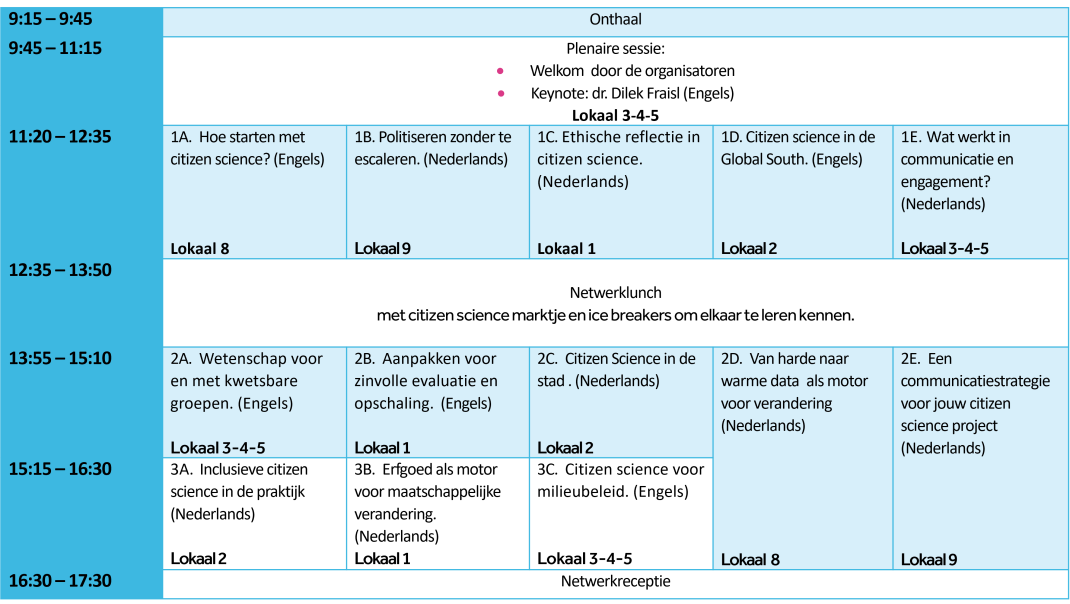
Between 11:20 and 12:35, you can take part in one of the following sessions.
1A. Introduction to citizen science (English)
Presentation and discussion
This session offers an introduction to citizen science. Many concrete examples and methods from different disciplines will be discussed. You will learn practical aspects for setting up your own initiative and discover how citizen science can be relevant for your organisation or field of interest.
Jef Van Laer (Scivil) - Download the presentation
1B. Politicising without escalation (Dutch)
Workshop
How do we create support and transcend differences between various stakeholders? Most challenges are multi-stakeholder problems; one actor alone cannot solve them. The tools and space to reach a multi-stakeholder solution—often the only sustainable one—are unfortunately often lacking. Using practical examples, we explore how you can politicise in a sustainable way.
1C. Ethical Reflection in Citizen Science (Dutch)
Presentations and follow-up discussion
What does working ethically in citizen science mean in everyday practice? In this session, we explore how to collaborate respectfully and transparently with participants, from data governance to relationships with participants. We discuss themes such as consent and data ownership, as well as ethical reflection on participation, roles, and expectations. Inspiring examples illustrate how ethical choices take shape in concrete projects.
1D. Citizen science in the Global South (English)
Pitches & panel discussion
This session explores how citizen science in the Global South goes beyond mere data collection and generates tangible impact on policy, communities, and daily life. Through concrete case studies from Africa and Latin America, speakers share practical insights on how citizen-generated data can be turned into meaningful policy dialogue and community empowerment, and reflect on what these experiences from the Global South can teach the wider citizen science community.
1E. What works in communication and engagement? (Dutch)
Presentations and follow-up discussion
In this session, we explore how targeted communication can not only reach people but also truly engage them. Through inspiring practical examples, speakers share what works (and what does not) in communication and engagement strategies, how to translate reach into active participation, and which factors contribute to sustained engagement of different target groups.
Download all presentations (merged into one file)
Between 13:55 and 15:10, you can take part in one of the following sessions.
2A. Science for and with vulnerable groups (English)
Presentation
This session offers an inspiring insight into practical experiences from four European projects. The central question is how to involve vulnerable target groups in research in a sustainable and meaningful way. We look more closely at methodological choices: how do you reach people, how do you stimulate active participation, how do you maintain their engagement, and what happens after the project ends? Expect a combination of insights on co-creation, concrete practical examples, and useful tips and tricks.
2B. From output to impact: approaches for meaningful evaluation and scaling (English)
Presentations and follow-up discussion
How can citizen science initiatives better understand, demonstrate, and strengthen their impact? This session explores practical ways to map and reflect on change, and shows how meaningful evaluation can support both learning and the scaling of impact.
2C. Citizen science in the city (Dutch)
Presentations
How can citizen science on urban mobility go beyond mere data collection? Based on successes and lessons learned, we explore how citizen science can contribute to awareness, policy dialogue, and concrete change in the city.
Francis Devlamynck (Beweging.net) & Katrien Voet (CM) - Luchtpijp - Download slides
2D. 13:55 – 16:30: From hard to warm data as a driver for change (Dutch)
Extended workshop – note: this workshop continues during parallel session 3!
How can we not only collect data, but also jointly explore the connections between data, people, and places? How do we move from hard to warm data? From individual to shared ownership? How can jointly interpreting data create movement within an action culture? In this session, we work with the conversation formats of the “wijkbaromotor” and co-creatively explore what work is needed to build these connections, based on a concrete case. The wijkbaromotor is not a tool, but an approach that combines data, conversation formats, and imagination in a specific place to strengthen the resilience of that neighbourhood.
Sarah Martens, Nathalie Lambrechts, Erik Laes (VITO) - Download slides
2E. 13:55 – 16:30: A communication strategy for your project (Dutch)
Extended workshop – note: this workshop continues during parallel session 3!
Do you want your project to truly make a difference in society? To motivate people to participate? To maintain engagement over the long term? To communicate results in a clear way? And to do all this in a way that fits you and your target audience? A communication strategy is essential. During this workshop, we will look for answers to the questions: who communicates, why, about what, with whom, and how? The workshop is interactive and practice-oriented: together we reflect on your challenges. The goal? You go home with a wealth of inspiration to get started with the communication of your research yourself.
Between 15:15 and 16:30, you can take part in one of the following sessions.
3A. Inclusive citizen science in practice (Dutch)
Presentations and follow-up discussion
How do you make citizen science accessible and relevant for diverse groups? In this panel, speakers share concrete experiences and approaches, with attention to barriers and success factors. The session offers practical insights for more inclusive projects.
3B. Heritage as a driver for societal change (Dutch)
Workshop
What we consider important from the past and pass on to the future: that is the essence of cultural heritage. Socially relevant research does not only look back, but also engages with current questions and future challenges. This works best when citizen scientists can actively contribute in different phases of the research. During this session, you will get to know several multidisciplinary citizen science projects in which heritage enriches research with a broader perspective. Afterwards, you will engage in dialogue with other participants and discover how to build bridges within your own project between historical information, current issues, and recommendations for the future.
3C. Citizen science for environment & policy (English)
Presentations and discussion
This session focuses on how citizen science can contribute to influencing policy on climate, energy, and the environment. Through inspiring practical examples, speakers show how data and insights from citizen science can feed into policy processes and societal change. We explore what is needed to move from scientific evidence to real policy impact, and what lessons can be learned from this.
3D. Continuation – 13:55 – 16:30: From hard to warm data as a driver for change (Dutch)
3E. Continuation – 13:55 – 16:30: A communication strategy for your project (Dutch)